Earthquake Monitoring Case Studies
Real-world seismic monitoring tests, field observations, and earthquake recording examples using Seismic Source systems and sensors.
Earthquake & Vibration Monitoring
Case studies covering earthquake recording, sensor response, vibration monitoring, raw seismic data, filtering, and long-term seismic data collection.
Long-Period Earthquake Recording Using a 2 Hz Geophone
Researcher: Seismic Source / John Giles
Location: Ponca City, Oklahoma area
Technology: Sigma 3, 2 Hz geophone, broadband seismic sensors, inverse response correction
This case study explores a practical earthquake monitoring question: can a conventional 2 Hz moving-coil geophone record useful seismic information far below its nominal natural frequency?
Over more than two years of field recording near Ponca City, Oklahoma, a 2 Hz geophone was tested alongside broadband seismic sensors on the same concrete slab. The system captured distant large earthquakes, regional events, local seismic activity, and a long-distance blast signal for direct comparison.
Events examined include the Greece M7 earthquake, Hawaii M6.9 earthquake, Glenwood Springs M3.7 earthquake, Sandwich Islands M7.1 earthquake, Fiji M8.2 earthquake, Alaska M7.9 earthquake, and the North Korea blast test recorded at approximately 10,000 km distance.
After applying digital inverse response correction, long-period signals that were nearly hidden in the raw 2 Hz geophone data became clearly observable and closely matched the broadband sensor recordings.
Earthquake Data Observations
Earthquake Examples Recorded with a Sigma 4
Researcher: Seismic Source / Scott Burkholder
Technology: Sigma 4, SEG-Y recording, raw and filtered seismic data, Visualizer
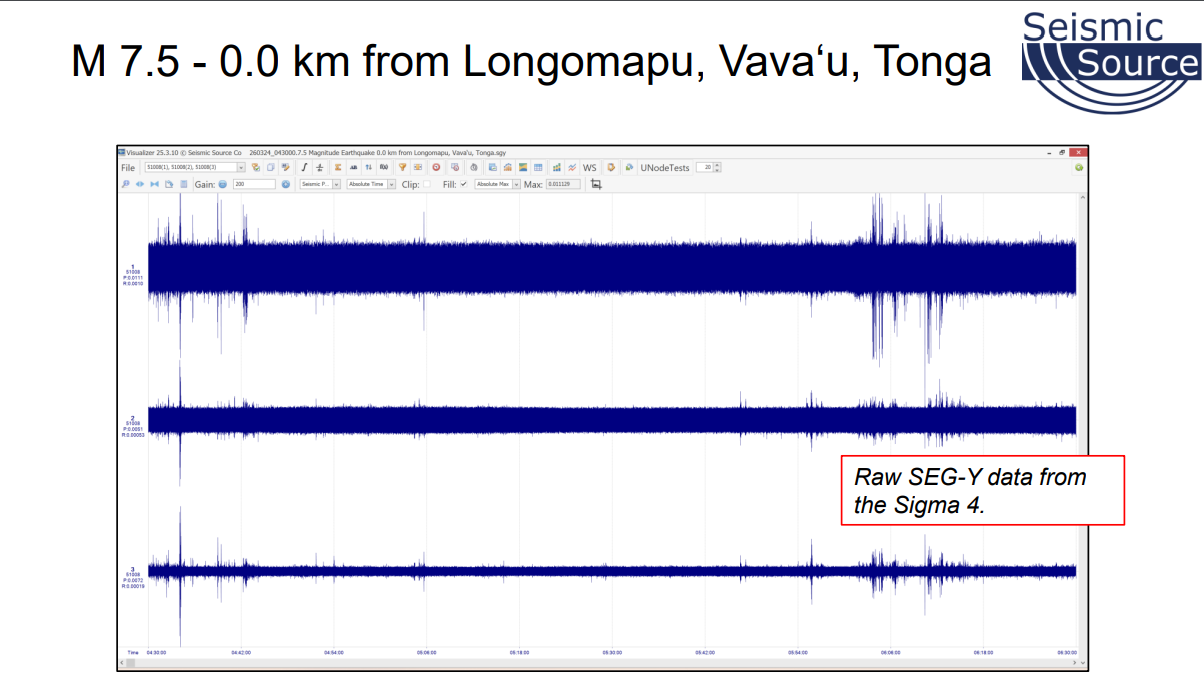
This observation set presents multiple earthquake recordings captured with a Sigma 4 system, showing both raw SEG-Y data and filtered SEG-Y data for comparison.
Events include examples from Wyoming, Oklahoma, Nebraska, Tonga, Japan, New Mexico, and Texas. Together, they show how local, regional, and distant earthquakes can be reviewed through raw and filtered seismic records.
M6.8 Uto, Kumamoto, Japan Earthquake Observation
Researcher: Seismic Source / Scott Burkholder
Recording Location: Denver, Colorado, USA
Technology: Sigma 4, time-variant spectral analysis,Visualizer
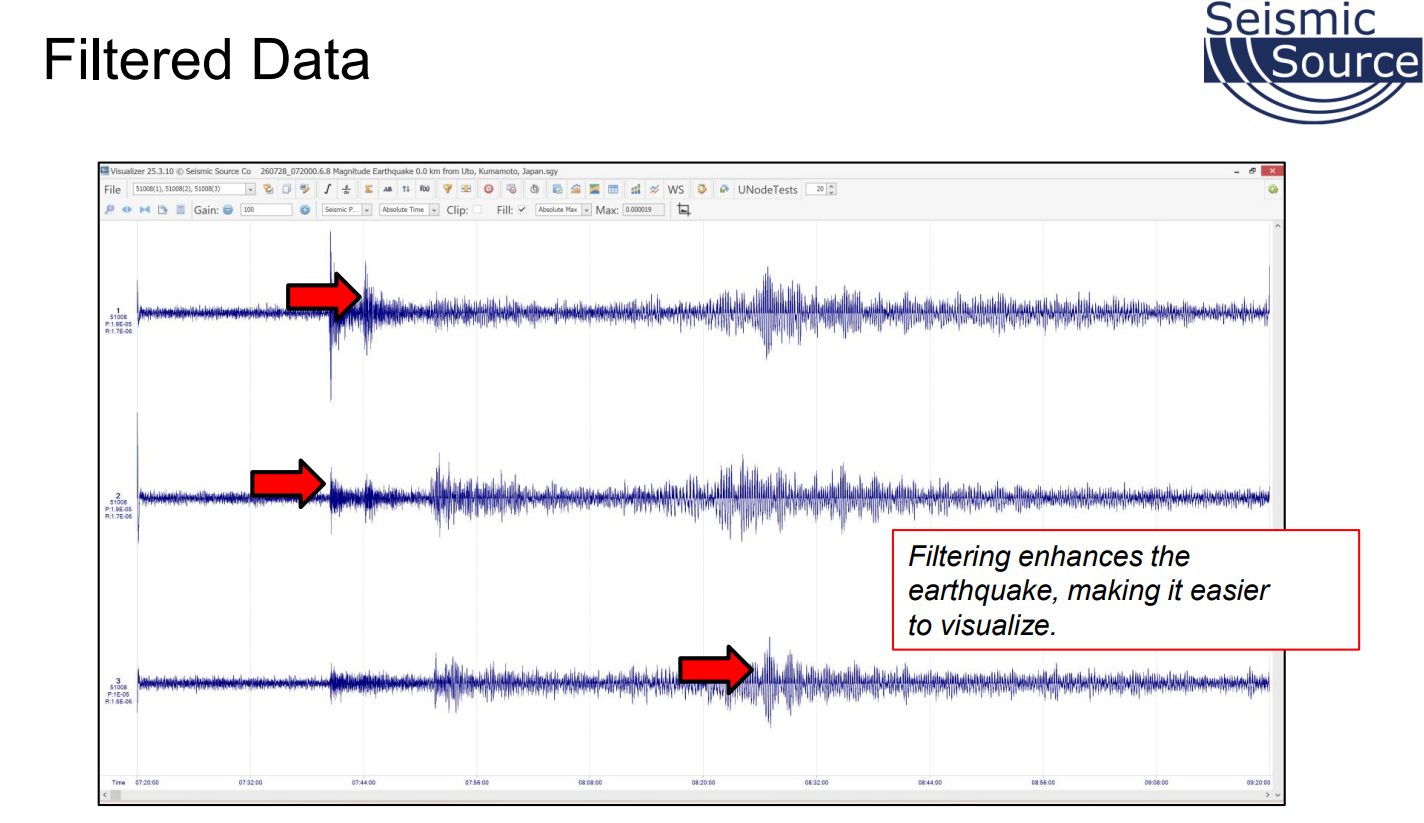
This observation follows a magnitude 6.8 earthquake near Uto, Kumamoto, Japan, recorded in Denver, Colorado on July 28, 2026. The data set shows two hours of raw digitizer data beginning shortly before the event arrival window.
The example highlights P-waves, S-waves, and surface waves using time-variant spectral analysis. It also shows how inverse and bandpass filtering make the earthquake signal easier to identify and visualize.