Event Monitor Software
Product information, applications, features, benefits, and brochure.
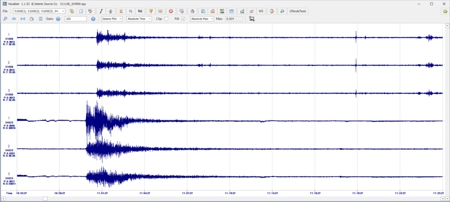
Event Monitor Software
Overview
The Event Monitor System from Seismic Source is a complete seismic monitoring solution designed to detect, evaluate, archive, and report seismic events across multiple monitoring stations and projects.
The system supports unattended local or remote monitoring using Sigma digitizing nodes, Remote Access Boxes, cloud-connected software, and integrated reporting tools. Monitoring stations can be deployed locally or remotely and accessed through secure Internet connections from anywhere in the world.
Event Monitor supports continuous 24/7/365 acquisition, automated event triggering, alarm generation, seismic analysis, real-time status monitoring, and automated report creation. The system architecture allows monitoring of multiple projects, multiple users, and multiple remote sites from a centralized back-office server.
Compatible seismographs include Sigma 3+, Sigma 4+, DAQ3-3, DAQlink 4, and DX-6 digitizers configured with geophones, accelerometers, or hydrophones.
Features
- Internet access for unattended monitoring of multiple arrays
- Easy access to event information from anywhere
- Remote monitoring of multiple projects
- Supports local and remote monitoring configurations
- Centralized server architecture
- Email alerts based on user-programmed thresholds and tolerances
- Peak amplitude event triggering
- RMS amplitude event triggering
- 1/3 octave RMS vector sum triggering
- Network-based event triggers
- Physical alarm and siren integration
- Multiple account and project management
- Remote configuration and control of digitizers
- Scheduled equipment testing
- Real-time status updates
- Evaluation of detected events
- Automated data collection and archiving
- Encrypted client-server communications
- Interactive status, command, and control interface
- Deploy and undeploy seismograph stations
- Monitor health of individual stations
- View event lists and individual events
- Overview of acquisition status
- Report generation tools
- Access system log files
- Interactive event analysis tools
- Velocity versus frequency charts
- PPV versus time analysis
- Dominant frequency analysis
- WTVA event display
- Filtering, gain, integration, and analysis tools
- Spectra analysis tools
- Automated color PDF reports
- Email reports to phone, tablet, or desktop
- Multi-lingual support
- Tolerance violations flagged automatically
- Customizable reports and email templates
- Troubleshooter reports for unit status changes
- Field-proven nodal seismograph hardware
- 3, 4, 6, 12, or 24 channel digitizer options
- Internal or external sensors
- Internal or external batteries
- Removable USB-compatible memory
- Wired Ethernet, Wi-Fi, or cellular communications
- Remote Access Box support
- Sigma 3+
- Sigma 4+
- DAQ3-3
- DAQlink 4
- DX-6
Benefits
- Remote Internet access allows operators and clients to monitor projects, alarms, and event activity from any location.
- Immediate email alerts and automated alarms help operators respond quickly to seismic events or equipment problems.
- The server architecture allows one system to manage multiple accounts, projects, stations, and users simultaneously.
- Automatic PDF report generation and email delivery simplify project documentation and compliance reporting.
- Interactive analysis tools and centralized data visualization improve understanding of vibration events and system performance.
- Remote configuration, remote monitoring, and automated status reporting reduce the need for field maintenance trips.
- The Event Monitor System supports multiple seismograph types, sensors, communications methods, and deployment configurations.
- Continuous 24/7/365 acquisition supports long-term infrastructure monitoring, industrial monitoring, and environmental vibration analysis.
Brochure
Event Monitor Software BrochureRelated Applications
Learn more about applications commonly used with this product.
- Monitor vibration levels around industrial facilities, construction sites, pipelines, and infrastructure.
- Monitor buildings, bridges, dams, and critical infrastructure for seismic or vibration-related events.
- Deploy local or remote monitoring stations connected through Ethernet, Wi-Fi, or cellular communications.
- Detect and analyze natural or induced seismic activity using automated triggering and reporting tools.
- Monitor blasting vibration levels and generate automated compliance reports.
- Continuous 24/7 acquisition supports permanent or semi-permanent monitoring deployments.