DX-6
Product information, applications, features, benefits, and brochure.
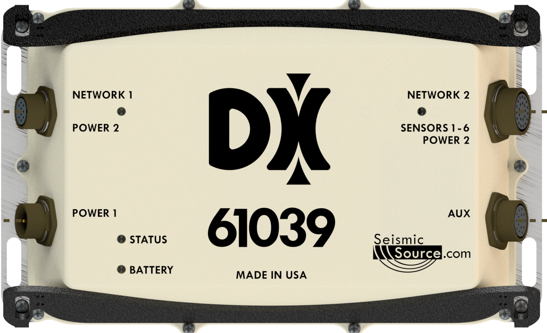
DX-6
Overview
The DX-6 is a rugged 6-channel seismograph node designed for autonomous recording, managed real-time acquisition, and flexible seismic field operations. With internal GPS, internal memory, optional external memory, and network operation, the DX-6 can be deployed almost anywhere, at any time.
The same DX-6 node can be used for autonomous GPS-controlled operation or linked together with cables or Wi-Fi for real-time command, status, QC, data collection, file harvest, and SEG-Y output. This makes the DX-6 useful for nodal recording, active-source surveys, passive monitoring, and hybrid acquisition projects.
DX-6 equipped systems support real-time noise monitoring, source tracking, quality control, and data offload. They are compatible with SourceLink and the full line of Seismic Source source control electronics, including Force 3, Boom Box 3, RTM3, and Universal Encoder 3.
Features
- Deploy a seismograph anywhere at any time
- Internal GPS disciplines the clock, locates the node, and provides accurate timing
- Internal memory plus optional external USB memory for data security and long-term operation
- Records with geophones, hydrophones, microphones, and accelerometers
- Scheduled wakeup and sleep times
- Low-power wireless radio built into the unit
- Nodes can be linked together with cables or Wi-Fi
- Real-time command and status
- Real-time quality control
- Real-time data collection
- File harvest and SEG-Y output
- Central computer can be moved off-line
- Map display shows field equipment with satellite, road, or terrain background
- Icon-based status shows battery, GPS, and test status for each node
- Data displays on-screen as it arrives
- Supports Vibroseis correlation
- Supports straight and diversity vertical stacking
- Schematic line deployment display with real-time noise monitor
- Supports 2D, 3D, and random spreads
- Supports 600+ channels per line
- Supports 32+ lines per spread
- Nodes automatically deployed using GPS
- Supports SEG-P1, GPX, and SPS files
- Nodes can be networked using cables or Wi-Fi
- Monitor noise and environmental conditions in real time
- No more shoot-blind acquisition
- Line Interface Units connect multiple lines and the Central Computer
- Central Computer manages spread, controls acquisition, and collects data
- Wi-Fi links can skip lines across roads, water, or obstacles
- Two network ports
- Upstream port supports 6 data channels and Ethernet
- Downstream port supports Ethernet with POE
- Battery port uses a three-pin connector and supports 12V batteries
- Auxiliary port includes ruggedized USB for data backup and external trigger
- 24-bit delta-sigma ADC
- 6 channels per node
- Dynamic range: 125 dB at 500 sps
- Distortion: 0.0001% at 500 sps
- Maximum input voltage: ±3.25V at x1 gain
- Noise: 0.15 µV RMS at x16 gain
- Bandwidth: DC to 85% Nyquist
- Sample rates from 125 sps to 64,000 sps
- Internal memory: 8 GB standard, upgradeable
- External memory: 16 GB standard, upgradeable
- Power requirement: 9 to 28 VDC
- Power draw: 2 watts at 12 volts
- Size: 292 x 184 x 48 mm / 11.5 x 7.25 x 2.25 inches
- Weight: 1.4 kg / 3.1 lbs
- Case type: aluminum and ABS plastic
Benefits
- The same DX-6 node can operate as an autonomous GPS-controlled recorder or as part of a managed cabled or Wi-Fi real-time acquisition system.
- Real-time noise monitoring, status, and QC help crews evaluate field conditions before and during acquisition.
- DX-6 can record with geophones, hydrophones, microphones, and accelerometers, making it useful for many seismic and monitoring applications.
- Support for 600+ channels per line and 32+ lines per spread allows DX-6 systems to scale for large projects.
- GPS-based deployment, map displays, and real-time node status help simplify layout, troubleshooting, and field management.
- Cabled and Wi-Fi links allow crews to skip across roads, water, or other obstacles without interrupting the receiver line.
- DX-6 works with SourceLink, Force 3, Boom Box 3, RTM3, and UE3 for precise source operation with multiple source types.
Brochure
DX-6 BrochureRelated Applications
Learn more about applications commonly used with this product.
- Deploy DX-6 nodes with GPS timing and internal storage for autonomous seismic acquisition.
- Use cabled or Wi-Fi networks for real-time command, status, QC, and data collection.
- Build large spreads with hundreds of channels per line and multiple lines per spread.
- Record passive data using geophones, hydrophones, microphones, or accelerometers.
- Use smaller DX-6 spreads for engineering, shallow seismic, and flexible field acquisition.
- Operate with Force 3, Boom Box 3, RTM3, and UE3 source control electronics.