Remote Trigger Module 3
Product information, applications, features, benefits, and brochure.
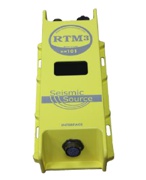
Remote Trigger Module 3
Overview
The Remote Trigger Module 3, or RTM3, is a new generation seismic timing and trigger device designed to synchronize impact sources and seismic recording systems. It can be used to synchronize a single source with one or more seismographs, or to synchronize multiple seismic recorders together.
RTM3 units use a high accuracy internal oscillator disciplined by GPS timing information. Once synchronized with a valid external GPS receiver, the RTM3 can continue operating without GPS signal for up to 10 minutes, helping maintain timing performance in difficult field conditions.
The RTM3 supports both integrated and autonomous acquisition modes. In integrated mode, it transmits source location and hit time information directly to the recorder. In autonomous mode, the RTM3 stores source timing, GPS location, and acquisition information internally for later download and analysis.
Features
- GPS-disciplined internal high accuracy oscillator
- Synchronizes seismic sources with one or more recorders
- Can synchronize multiple seismic recording systems
- Maintains timing for up to 10 minutes without GPS after synchronization
- Stores microsecond-accurate hit and time break information
- Operates in autonomous mode without radio communication
- Uses individual time slots to prevent multiple sources from starting at the same time
- Stores source information on non-volatile memory for later download
- Ideal for rugged terrain, thick vegetation, and poor radio coverage
- No radios, no repeaters, no problem
- Transmits source location and hit times directly to the recorder
- Allows observer-controlled acquisition workflows
- Supports multiple source units and production monitoring
- Can send start signals from sources to seismographs
- One source can start several seismographs, or multiple sources can start one recording system
- Integrated radio interface works with most radios
- Integrated GPS interface sends source location back to the recording system
- Integrated Ethernet for direct SourceLink control
- Wi-Fi option for setup using a phone, tablet, or notebook computer
- Web browser interface for viewing and changing parameters
- Operates seamlessly with UE3, Force 3, and Boom Box 3 units
- Compatible with most seismic sources
- Works with hammer switches, sledgehammers, elastic band weight drops, and AWD sources
- Dual-purpose design can be used as Encoder or Decoder
- Recommended for use with SSC’s Universal Encoder 3
- Compatible with standard radios
- Compatible with standard timing
- Compatible with standard crews
- Supports conventional acquisition workflows
Benefits
- GPS-disciplined timing and microsecond-accurate hit information help improve source timing accuracy and recording confidence.
- Autonomous mode allows crews to acquire data where radio communication is unreliable or unavailable.
- RTM3 can be used with small hammer sources, medium-scale elastic weight drops, large accelerated weight drops, and other impact sources.
- Wi-Fi browser setup allows crews to configure and review RTM3 settings from common phones, tablets, or notebook computers.
- RTM3 stores source location, hit time, and acquisition information internally for later download, verification, and reporting.
- Legacy mode keeps the RTM3 compatible with standard radios, standard timing, and conventional seismic crews.
Brochure
Remote Trigger Module 3 BrochureRelated Applications
Learn more about applications commonly used with this product.
- Trigger and synchronize hammer sources, weight drops, and other impact seismic sources.
- Use RTM3 with AWD systems to transmit hit times, source location, and time break information to recording systems.
- Ideal for smaller impact-source surveys using sledgehammers, elastic weight drops, or compact sources.
- Acquire data without radio communication using pre-allocated GPS time slots and internal data storage.
- Synchronize one source with multiple recorders or coordinate several seismic recording systems.