DAQlink 5-24
Product information, applications, features, benefits, and brochure.
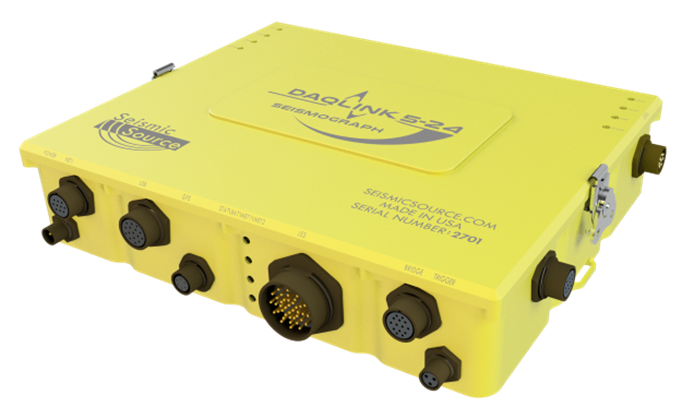
DAQlink 5-24
Overview
The DAQlink 5-24 is a high-resolution, 24-channel portable seismograph designed for active-source acquisition, passive monitoring, refraction surveys, and distributed seismic recording. It combines high-speed 24-bit ADC performance, compact size, low power operation, and flexible Ethernet networking.
DAQlink 5 is the fifth generation of portable seismograph systems. It can be configured as a stand-alone monitoring system, a refraction system, or as part of a distributed seismic reflection system. Vscope software provides acquisition control, data QC, and file storage.
Multiple DAQlink 5-24 units can be stacked or networked together for larger high-channel-count systems, making the system useful for small crews, downhole acquisition, marine seismic, and large distributed seismic projects.
Features
- 1 to 24 channels per seismograph
- High-speed 24-bit ADC up to 64,000 samples per second
- Wide bandwidth from DC to 27 kHz
- Low distortion: better than 0.00008% THD at 500 sps
- Wide dynamic range greater than 124 dB at 500 sps typical
- Low noise: less than 0.15 µV RMS at 500 sps typical
- GPS clock discipline for continuous recording
- PTP support to synchronize multiple units
- VHF/UHF radio timing for underground use
- Trigger accuracy of ±1 microsecond at any sampling frequency
- Trigger on hammer switch for shot acquisition
- Trigger using GPS time for noise monitoring
- Trigger using LTA/STA for event monitoring
- Two trigger circuits available, one standard and one for low-voltage inputs
- 16 GB internal memory card standard
- Optional external USB-compatible memory plug for backup and transfer
- Ethernet connection for fast data transfer and remote storage
- Internal FTP server for external data access
- Use network connection to configure the seismograph and monitor acquisition
- Compatible with cable, Wi-Fi, and cellular data connections
- Optional network extenders connect DAQlinks together for high-channel-count systems
- Supports real-time data transfer
- Instrument tests for distortion, cross-feed, CMRR, impulse, and noise
- Sensor tests for resistance, frequency, damping, and sensitivity
- Internal tests verify both the instrument and geophone spread
- Stack units together for 48-channel and larger systems
- A single GPS module can synchronize all units in a DAQlink stack
- Supports distributed node-style systems using 100Base-T networks
- Data can be stored in RAW, SEG-2, SEG-D, SEG-Y, ASCII, CSV, and MiniSEED formats
- Power requirements: 11 to 28 VDC
- Power consumption: less than 0.13 watts per channel
- Size: 280 x 246 x 56 mm / 11.0 x 9.7 x 2.2 inches
- Weight: 2.0 kg / 4.4 pounds
- Operating temperature: -40°C to 80°C
- Sturdy milled aluminum case with IP67 weatherproof seal
Benefits
- DAQlink 5-24 can be used for active-source work, passive monitoring, refraction, reflection, downhole, and distributed seismic acquisition.
- Stackable and networked operation allows crews to expand from a compact 24-channel system to larger high-channel-count systems.
- High dynamic range, low noise, wide bandwidth, and 24-bit acquisition help capture clean seismic data in demanding field conditions.
- Ethernet control, Vscope software, built-in testing, and flexible storage options simplify setup, QC, and data management.
- Continuous recording, cellular data support, FTP access, and event detection make DAQlink 5 suitable for remote monitoring projects.
- DAQlink 5 is compatible with Force 3, Boom Box 3, RTM3, and Universal Encoder 3 source control equipment.
- Compact size, low power consumption, and rugged IP67 construction make the system easier to deploy in remote field environments.
Brochure
DAQlink 5-24 BrochureRelated Applications
Learn more about applications commonly used with this product.
- Use with a sledgehammer, hammer switch, geophones, and small crews for MASW, refraction, and shallow seismic work.
- Network multiple DAQlink units together for larger distributed seismic acquisition projects.
- Supports downhole sensor recording and monitoring applications.
- Use continuous recording, GPS timing, and event detection for passive seismic monitoring.
- Use multiple DAQlink 5-24 units for ultra-high-resolution marine seismic acquisition.
- Use LTA/STA triggering and automatic notifications to detect and monitor seismic events.