WTB 4
Product information, applications, features, benefits, and brochure.
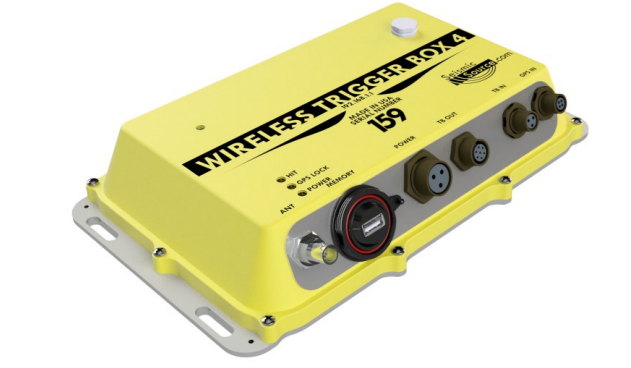
WTB 4
Overview
The Wireless Trigger Box 4, or WTB 4, is a wireless trigger system for mechanical impact sources. It detects a source firing event and wirelessly triggers one or more seismographs using GPS timing and VHF radio communication.
A typical WTB 4 system uses two units. One WTB 4 connects to the source and detects the trigger pulse from a hammer switch or other impact device. A second WTB 4 connects to the seismograph, receives the source trigger message, and starts the recorder.
Each WTB 4 includes an internal Radio Trigger Module, 3 watt VHF radio, 99 watt-hour rechargeable battery, internal GPS, and standard Wi-Fi. The system supports flexible 2D and 3D layouts where one source can trigger multiple seismographs, or one recorder can receive trigger messages from multiple sources.
Features
- Wirelessly triggers seismographs from mechanical impact sources
- Detects hammer switch or source trigger closure
- Transmits trigger time and position from source to recorder
- Supports multiple sources and multiple seismographs
- Useful for 2D or 3D seismic configurations
- Source WTB 4 detects the trigger pulse from the source
- Recorder WTB 4 receives the source message
- Recorder WTB 4 starts the seismograph
- Source WTB 4 can trigger multiple WTB 4 equipped seismographs
- Recorder WTB 4 can receive trigger messages from multiple WTB 4 equipped sources
- Internal Radio Trigger Module
- Internal 3 watt VHF radio
- Internal 99 watt-hour rechargeable battery
- Internal GPS module
- Internal Wi-Fi standard
- Each WTB 4 acquires GPS lock using internal or optional external GPS
- Source WTB 4 detects the falling edge of the source trigger signal
- Source WTB 4 calculates GPS time of the event
- Source WTB 4 transmits GPS time and position by VHF radio
- Recorder WTB 4 triggers the seismograph exactly 1/2 second after the source trigger time
- Trigger signal: TTL or switch closure
- Trigger input detects negative edge
- Trigger output: TTL negative pulse
- Radio cycle time: 500 milliseconds
- Accuracy: ±1 microsecond
- Radio: 3 watt
- Radio range: 1 mile, or up to 3 miles with optional 1/2 wave antenna depending on terrain
- Removable external memory backs up time breaks at the source
- External GPS module for mounting GPS outside the source
- 99.9 watt-hour Li-Ion internal battery
- External 1/2 wave radio antenna extends radio range
- Navigation App allows navigation and WTB 4 status viewing
- Weight: 4.5 lbs / 2 kg with radio and battery
- Size: 11.5 x 7.25 x 3.0 inches
- Size: 292 x 184 x 76 mm
- Runs up to 24 hours depending on use
Benefits
- WTB 4 eliminates long trigger cables between the impact source and the seismograph, simplifying field setup.
- One source can trigger multiple recorders, and one recorder can receive trigger messages from multiple sources.
- GPS event timing with ±1 microsecond accuracy provides reliable trigger timing for seismic acquisition.
- Wireless VHF triggering helps crews operate across roads, rough terrain, vegetation, or areas where trigger cables are impractical.
- Optional removable memory stores source GPS time and position for backup and later review.
- WTB 4 works well with hammer switches, weight drops, and other mechanical impact sources used in near-surface seismic work.
Brochure
WTB 4 BrochureRelated Applications
Learn more about applications commonly used with this product.
- Wirelessly trigger seismographs from hammer switches, weight drops, and other impact sources.
- Useful for MASW, refraction, and shallow seismic projects where wired trigger lines are inconvenient.
- Deploy multiple source and recorder systems in flexible 2D or 3D configurations.
- Use VHF radio triggering where the source and recorder are separated by terrain or field obstacles.
- Trigger DAQlink, GeoDAQ, or other seismographs from accelerated weight drop systems.