Sigma 3+
Product information, applications, features, benefits, and brochure.
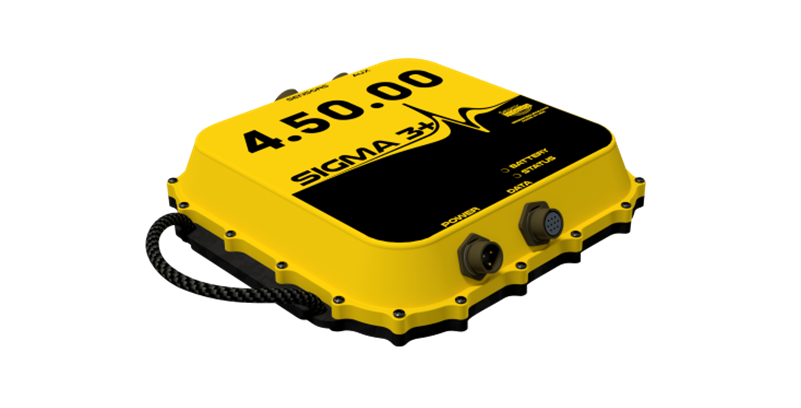
Sigma 3+
Overview
The Sigma 3+ is a robust and versatile nodal seismograph designed for autonomous recording, monitoring, and active-source seismic acquisition. It builds on the performance of the original Sigma system while using a new streamlined case design that is smaller, lighter, and easier to deploy in the field.
The Sigma 3+ provides continuous recording as standard, making it well suited for autonomous operation, long-term monitoring, and passive seismic applications. Internal GPS provides clock discipline and location information, while mesh radio, cable, Wi-Fi, or cellular Ethernet options support command, control, and field data offload.
The system supports active-source acquisition with vibroseis, dynamite, and impulsive sources, as well as passive applications including hydraulic fracturing monitoring, surface wave acquisition, long-term permanent monitoring, and earthquake monitoring.
Features
- New streamlined case design
- Smaller size with 60% less volume than the original Sigma 3
- Less weight with 40% reduction compared to the original Sigma 3
- Same excellent performance as the Sigma Box
- Compact rugged design for field deployment
- Continuous recording standard for monitoring and autonomous operation
- Internal GPS for clock discipline and location information
- VHF or wire timing option for mining and underground projects without GPS
- Maximum trace length supports continuous recording
- Sample rates from 125 to 4000 samples per second
- Mesh radio network for deployment, command, and control of nodes
- Cable, Wi-Fi, or cellular Ethernet support
- In-field data offload while recording
- Ruggedized 10-pin 100Base-Tx Ethernet connection
- Ruggedized 19-pin external USB connection
- Hot-swap external storage option
- Collect data without interrupting operation
- Hot-swap battery option
- Change batteries without interrupting operation
- Three input channels
- Battery power output for active sensors
- Supports accelerometers and broadband sensors
- Low x1 and high x16 preamp gains
- 20 kOhm input impedance
- Active source acquisition software
- Local or remote event monitoring software
- Long-term continuous recording software
- Supports autonomous and monitoring workflows
- Typical dynamic range: 126 dB low gain, 122 dB high gain at 500 sps
- Typical harmonic distortion: 0.0001% at 500 sps
- Typical noise floor: 0.8 µV RMS low gain, 0.08 µV RMS high gain
- Bandwidth from DC to 85% Nyquist
- Digital low-cut filters
- Internal memory: 8 GB
- Power requirement: 0.4 watts per channel
- Voltage requirement: 9 to 28 volts
- Size: 271 x 286 x 55 mm / 10.7 x 11.3 x 2.2 inches
- Weight: 3 lbs 2 oz / 1.4 kg
- Operating temperature: -40°C to 80°C
- Rugged IP67 case
Benefits
- The streamlined Sigma 3+ case is smaller and lighter than the original Sigma 3, helping field crews deploy and retrieve nodes more efficiently.
- Continuous recording as standard supports autonomous acquisition, monitoring, and long-term seismic recording applications.
- Mesh radio, cable, Wi-Fi, and cellular Ethernet options provide multiple ways to command, control, and offload data in the field.
- Hot-swap storage and battery options allow crews to collect data or replace batteries without interrupting operation.
- The Sigma 3+ can be used for vibroseis, dynamite, impulsive source acquisition, hydraulic fracturing monitoring, surface wave work, and earthquake monitoring.
- The rugged IP67 case and wide operating temperature range support reliable field operation in demanding seismic environments.
Brochure
Sigma 3+ BrochureRelated Applications
Learn more about applications commonly used with this product.
- Use continuous recording and internal GPS timing for autonomous seismic acquisition projects.
- Acquire active-source data with vibroseis, dynamite, or impulsive source systems.
- Use Sigma 3+ nodes for passive monitoring during hydraulic fracturing operations.
- Support local or remote seismic event monitoring and long-term continuous recording.
- Use Sigma 3+ for surface wave acquisition and passive seismic studies.
- VHF or wire timing options support projects where GPS timing is difficult or unavailable.